
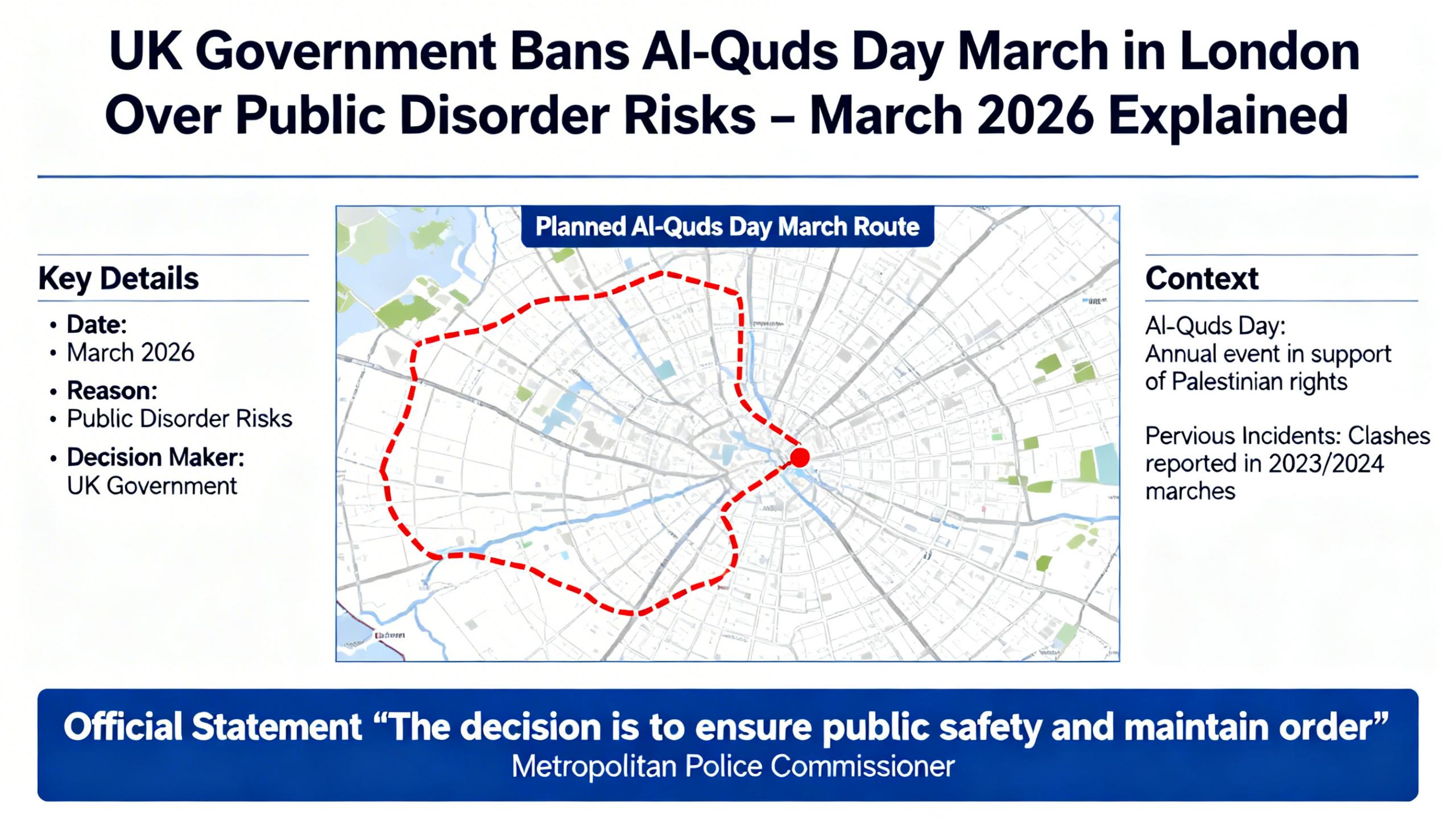
On 11 March 2026, the United Kingdom’s Home Secretary, Shabana Mahmood, approved a request from the Metropolitan Police to prohibit the annual Al-Quds Day procession in London scheduled for 15 March. The decision marks the first outright ban on a protest march in the capital since 2012 and has prompted widespread discussion concerning public order, national security, and the boundaries of lawful assembly.
The prohibition, enacted under Section 13 of the Public Order Act 1986, extends to any related processions for a full month and was justified by reference to the elevated risk of serious public disorder arising from the anticipated scale of the demonstration and multiple counter-protests. A static gathering at an alternative location remains permissible.
Origins of Al-Quds Day
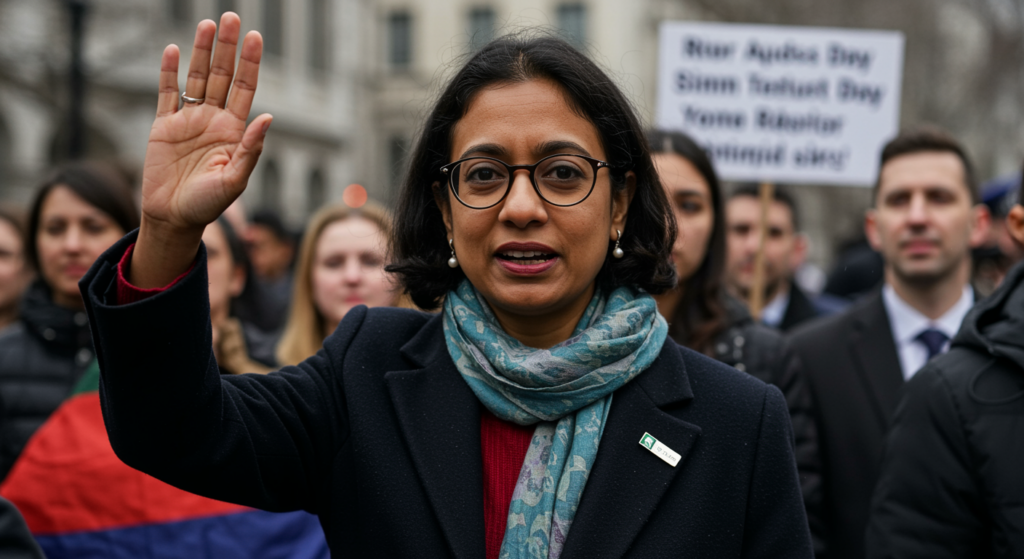
Al-Quds Day was instituted in 1979 by Ayatollah Ruhollah Khomeini, shortly after the Iranian Revolution. The term “Al-Quds” is the Arabic name for Jerusalem. Khomeini designated the last Friday of Ramadan as an international day of solidarity with the Palestinian people and opposition to Israeli occupation. The observance has since been observed annually in Iran and in various cities worldwide, including London, where it has been held continuously for more than four decades.
Organiser and Links to the Islamic Human Rights Commission
In the United Kingdom the event is coordinated by the UK Al-Quds Committee, an umbrella group in which the Islamic Human Rights Commission (IHRC) plays a prominent role. The IHRC, established in 1997, describes itself as an independent non-profit organisation advocating for human rights irrespective of race, faith, or political affiliation. Metropolitan Police statements have characterised the organisers as “supportive of the Iranian regime,” a description the IHRC rejects. The Commission maintains that the march is a non-confessional, family-oriented demonstration focused exclusively on Palestinian rights and opposition to occupation.
Legal Threshold and Rarity of the Ban
UK law sets a high threshold for prohibiting a procession. Under Section 13 of the Public Order Act 1986, the Metropolitan Police Commissioner must be satisfied that the event would cause serious public disorder and that no lesser conditions could mitigate the risk. Assistant Commissioner Ade Adelekan confirmed that the force had not invoked this power since 2012, when far-right English Defence League marches were similarly restricted. The current prohibition therefore represents an exceptional measure applied only after careful assessment.
Government Rationale and Connection to Middle East Tensions
Home Secretary Mahmood stated that she was “satisfied doing so is necessary to prevent serious public disorder, due to the scale of the protest and multiple counter-protests, in the context of the ongoing conflict in the Middle East.” Police assessments highlighted the “uniquely contentious” nature of the march, citing concerns over potential clashes, historical incidents involving support for proscribed organisations such as Hezbollah, and the broader regional volatility involving Iran. The decision was taken in close consultation with security services and reflects the government’s primary duty to maintain public safety.
Organiser Response
Spokesperson Faisal Bodi of the IHRC described the ban as “a sad day for freedom of expression, freedom of assembly and the right of people to legitimately protest.” The organisation has announced that a static protest will proceed and has launched an urgent judicial review in the High Court, arguing that the prohibition constitutes an unjustified interference with protected rights. Fundraising efforts are under way to support the legal challenge. Organisers anticipate that the publicity generated by the ban may increase attendance at the permitted gathering.
Free Speech Debates
The prohibition has reignited debate over the limits of protest rights in the United Kingdom. Critics contend that the measure sets a dangerous precedent and disproportionately restricts peaceful advocacy for Palestinian causes. Supporters of the government’s action emphasise that public safety and the prevention of disorder outweigh unrestricted procession rights, particularly when counter-demonstrations and security intelligence indicate heightened risk. The Metropolitan Police and Home Office have stressed that the ban does not preclude expression of views; participants may still assemble statically and voice their positions lawfully.
Historical Comparisons
For over forty years the Al-Quds Day march proceeded in London without prohibition, even amid previous regional tensions. Past events occasionally resulted in arrests for offences including support for banned terrorist organisations and antisemitic incidents, yet police had managed the procession through conditions rather than outright bans. The 2012 restriction on English Defence League marches remains the most recent comparable precedent until the present decision. The current context—marked by acute Middle East conflict involving Iran—has evidently altered the risk calculus sufficiently to meet the statutory threshold.Conclusion
The banning of the 2026 Al-Quds Day march illustrates the complex balance authorities must strike between safeguarding public order and upholding the right to peaceful protest. While the decision has drawn criticism from civil liberties advocates and the organisers, it rests on a statutory framework applied only after rigorous evaluation. The ongoing judicial review will provide further legal clarity on whether the prohibition was proportionate. In the interim, the event’s transformation into a static demonstration underscores both the resilience of pr