
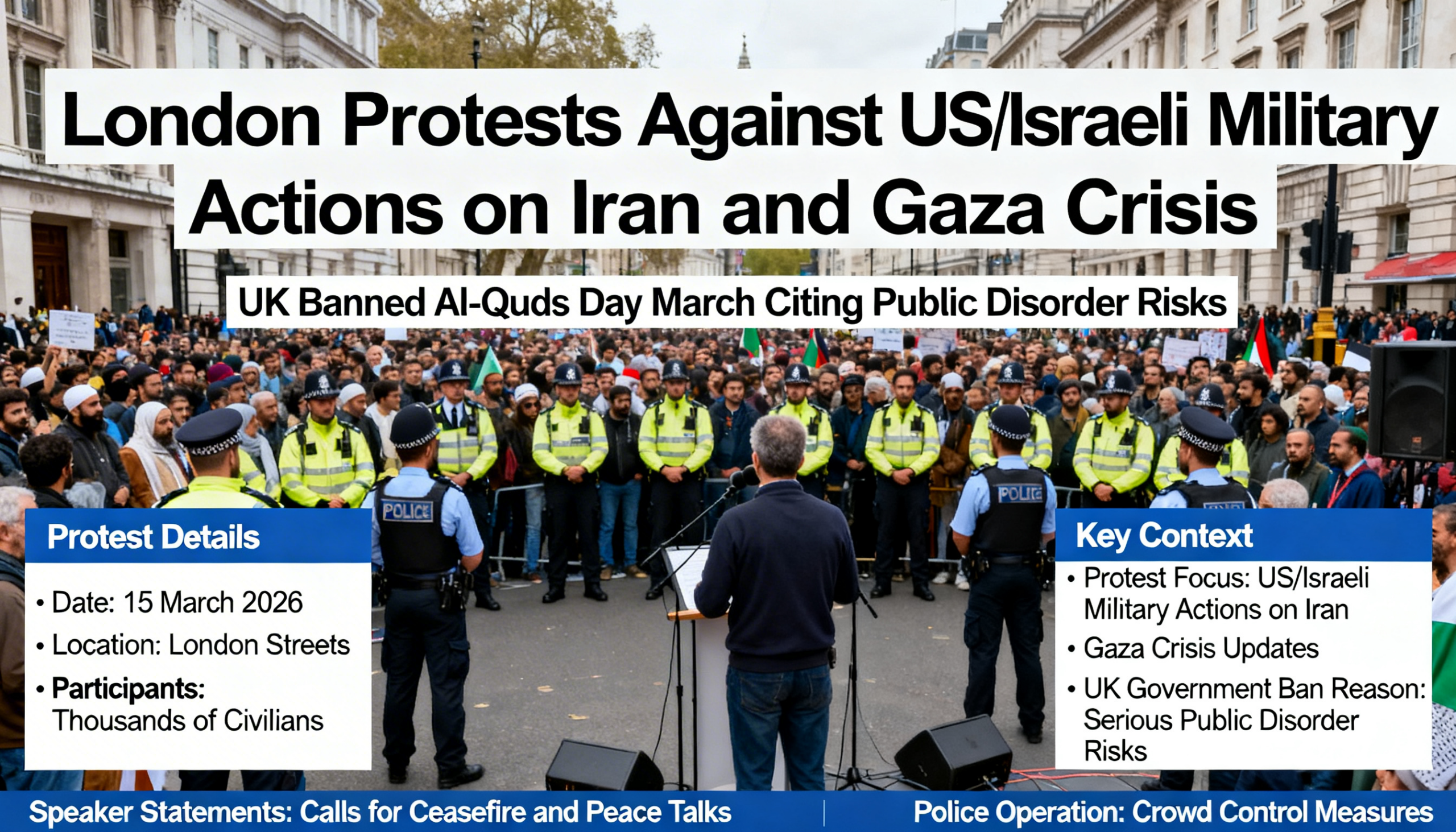
Thousands demonstrated in central London against the US-Israeli conflict with Iran and Gaza crisis after the government banned the annual Al-Quds Day march amid public disorder fears. Full report and analysis.
On 15 March 2026, hundreds of demonstrators gathered in central London for a static rally marking Al-Quds Day, an annual event in solidarity with Palestinians that has been held in the United Kingdom for over 40 years. The traditional march was prohibited by the UK government following a formal request from the Metropolitan Police and approval by Home Secretary Shabana Mahmood. Authorities cited the risk of “serious public disorder” arising from the anticipated scale of the event, multiple counter-protests, and the volatile situation in the Middle East, where US and Israeli military operations against Iran have been ongoing since 28 February 2026.
Reasons for the Ban and Shift to Static Demonstration
The Metropolitan Police submitted the request, noting that the organisers—the Islamic Human Rights Commission—were “supportive of the Iranian regime” and that intelligence assessments indicated a heightened threat of violence between protesters and counter-protesters. Home Secretary Shabana Mahmood approved the prohibition, stating: “I am satisfied doing so is necessary to prevent serious public disorder, due to the scale of the protest and multiple counter-protests, in the context of the ongoing conflict in the Middle East.” The ban, enacted under Section 13 of the Public Order Act, applied to the march and any associated processions for one month—the first such prohibition of a protest march in London since 2012.
Organisers proceeded with a permitted static demonstration on the Albert Embankment along the south bank of the River Thames, restricted to the period between 1pm and 3pm. Police deployed more than 1,000 officers and used the river itself as a physical barrier, with patrol boats and the closure of Lambeth Bridge to separate participants from a counter-protest on the north bank at Millbank. This arrangement prevented any movement along the planned route to the Home Office.
Scale of the Protest and Police Response
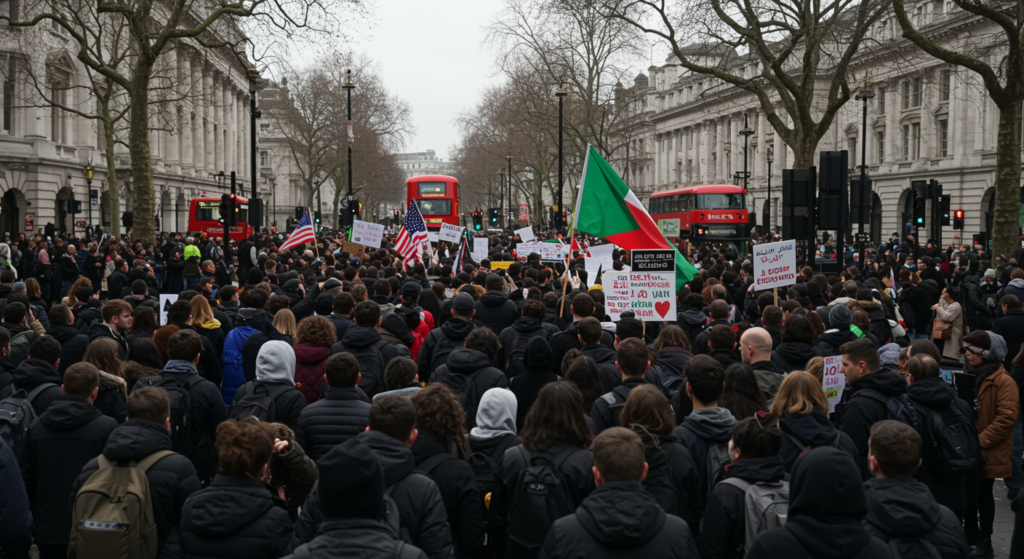
Pre-event estimates had suggested up to 12,000 attendees, yet actual turnout was in the hundreds on both sides of the Thames. Despite the restrictions, the event drew significant attention, with participants waving Palestinian flags, holding banners, and chanting slogans including “From the river to the sea,” “Israel is a terror state,” and expressions of solidarity with Iran. Twelve arrests were made for offences including support for proscribed organisations, affray, and threatening or abusive behaviour. Police are also investigating chants of “death to the IDF” led by musician Bobby Vylan.
Speaker Quotes Criticising UK Policy
Speakers and participants directly criticised UK government policy. Organiser Faisal Bodi described the ban as a “sad day for freedom of expression” and suggested the publicity might result in larger future turnouts. Protester Georgie Stagg stated: “You can’t criticise the Iranian government for being anti-democratic when we’ve got a government here that’s arresting people holding placards.” Fereydun Bahrami held a placard reading “Stop Using UK bases to bomb Iran” and declared: “We are here to celebrate Al-Quds Day and also protest against the war.” Salma, a London freight worker, questioned US and Israeli actions: “Fighting back and standing up to the Americans is right – Trump had no right to go in and take out an 86-year-old leader.” Bobby Vylan told the crowd: “A hate march is what they call it – but we do not operate from a place of hatred, we operate from a place of love. We must strive to remain human in a world that is ruled by monsters.”
Links to Middle East Escalation
The demonstration occurred against the backdrop of escalating conflict in the Middle East. Since 28 February 2026, US and Israeli strikes have targeted Iranian military infrastructure and leadership, resulting in the reported death of Supreme Leader Ayatollah Ali Khamenei and over 2,000 casualties across the region. Iran has responded with missile and drone attacks. Protesters linked the UK ban to perceived alignment with US-Israeli policy, including the use of British bases, and condemned ongoing actions in Gaza as genocide. The event explicitly called for “Hands Off Iran” while reaffirming solidarity with Palestinians.
Public Reactions and Potential for Future Unrest
Reactions were polarised. Government figures, including Shadow Home Secretary Chris Philp and former independent adviser Lord Walney, supported the ban as a necessary measure. London Mayor Sadiq Khan emphasised that the decision targeted this specific event without broadly restricting protest rights. Counter-protesters, including Iranian exiles, welcomed the restrictions and expressed support for actions against the Iranian regime.
On the protesters’ side, many viewed the ban as an erosion of democratic freedoms and an example of capitulation to external lobbies. Organisers accused police of yielding to “Zionist” pressure and vowed continued resistance. The month-long prohibition, combined with the publicity generated by the decision, may inadvertently fuel greater mobilisation in future demonstrations. Analysts note that the episode underscores deepening societal divisions in the UK over foreign policy amid the Iran conflict and Gaza crisis, raising the prospect of further protests, legal challenges, or heightened tensions as the Middle East situation evolves. Police described the operation as successful in maintaining order, yet the underlying grievances remain unresolved.
This event illustrates the complex balance between public safety and the right to protest in a democracy facing international pressures. As the one-month ban period continues, close monitoring of related gatherings will be essential to assess risks of renewed unrest.Thousands demonstrated in central London against the US-Israeli conflict with Iran and Gaza crisis after the government banned the annual Al-Quds Day march amid public disorder fears. Full report and analysis.
On 15 March 2026, hundreds of demonstrators gathered in central London for a static rally marking Al-Quds Day, an annual event in solidarity with Palestinians that has been held in the United Kingdom for over 40 years. The traditional march was prohibited by the UK government following a formal request from the Metropolitan Police and approval by Home Secretary Shabana Mahmood. Authorities cited the risk of “serious public disorder” arising from the anticipated scale of the event, multiple counter-protests, and the volatile situation in the Middle East, where US and Israeli military operations against Iran have been ongoing since 28 February 2026.
Reasons for the Ban and Shift to Static Demonstration
The Metropolitan Police submitted the request, noting that the organisers—the Islamic Human Rights Commission—were “supportive of the Iranian regime” and that intelligence assessments indicated a heightened threat of violence between protesters and counter-protesters. Home Secretary Shabana Mahmood approved the prohibition, stating: “I am satisfied doing so is necessary to prevent serious public disorder, due to the scale of the protest and multiple counter-protests, in the context of the ongoing conflict in the Middle East.” The ban, enacted under Section 13 of the Public Order Act, applied to the march and any associated processions for one month—the first such prohibition of a protest march in London since 2012.
Organisers proceeded with a permitted static demonstration on the Albert Embankment along the south bank of the River Thames, restricted to the period between 1pm and 3pm. Police deployed more than 1,000 officers and used the river itself as a physical barrier, with patrol boats and the closure of Lambeth Bridge to separate participants from a counter-protest on the north bank at Millbank. This arrangement prevented any movement along the planned route to the Home Office.
Scale of the Protest and Police Response
Pre-event estimates had suggested up to 12,000 attendees, yet actual turnout was in the hundreds on both sides of the Thames. Despite the restrictions, the event drew significant attention, with participants waving Palestinian flags, holding banners, and chanting slogans including “From the river to the sea,” “Israel is a terror state,” and expressions of solidarity with Iran. Twelve arrests were made for offences including support for proscribed organisations, affray, and threatening or abusive behaviour. Police are also investigating chants of “death to the IDF” led by musician Bobby Vylan.
Speaker Quotes Criticising UK Policy
Speakers and participants directly criticised UK government policy. Organiser Faisal Bodi described the ban as a “sad day for freedom of expression” and suggested the publicity might result in larger future turnouts. Protester Georgie Stagg stated: “You can’t criticise the Iranian government for being anti-democratic when we’ve got a government here that’s arresting people holding placards.” Fereydun Bahrami held a placard reading “Stop Using UK bases to bomb Iran” and declared: “We are here to celebrate Al-Quds Day and also protest against the war.” Salma, a London freight worker, questioned US and Israeli actions: “Fighting back and standing up to the Americans is right – Trump had no right to go in and take out an 86-year-old leader.” Bobby Vylan told the crowd: “A hate march is what they call it – but we do not operate from a place of hatred, we operate from a place of love. We must strive to remain human in a world that is ruled by monsters.”
Links to Middle East Escalation
The demonstration occurred against the backdrop of escalating conflict in the Middle East. Since 28 February 2026, US and Israeli strikes have targeted Iranian military infrastructure and leadership, resulting in the reported death of Supreme Leader Ayatollah Ali Khamenei and over 2,000 casualties across the region. Iran has responded with missile and drone attacks. Protesters linked the UK ban to perceived alignment with US-Israeli policy, including the use of British bases, and condemned ongoing actions in Gaza as genocide. The event explicitly called for “Hands Off Iran” while reaffirming solidarity with Palestinians.
Public Reactions and Potential for Future Unrest
Reactions were polarised. Government figures, including Shadow Home Secretary Chris Philp and former independent adviser Lord Walney, supported the ban as a necessary measure. London Mayor Sadiq Khan emphasised that the decision targeted this specific event without broadly restricting protest rights. Counter-protesters, including Iranian exiles, welcomed the restrictions and expressed support for actions against the Iranian regime.
On the protesters’ side, many viewed the ban as an erosion of democratic freedoms and an example of capitulation to external lobbies. Organisers accused police of yielding to “Zionist” pressure and vowed continued resistance. The month-long prohibition, combined with the publicity generated by the decision, may inadvertently fuel greater mobilisation in future demonstrations. Analysts note that the episode underscores deepening societal divisions in the UK over foreign policy amid the Iran conflict and Gaza crisis, raising the prospect of further protests, legal challenges, or heightened tensions as the Middle East situation evolves. Police described the operation as successful in maintaining order, yet the underlying grievances remain unresolved.
This event illustrates the complex balance between public safety and the right to protest in a democracy facing international pressures. As the one-month ban period continues, close monitoring of related gatherings will be essential to assess risks of renewed unrest.